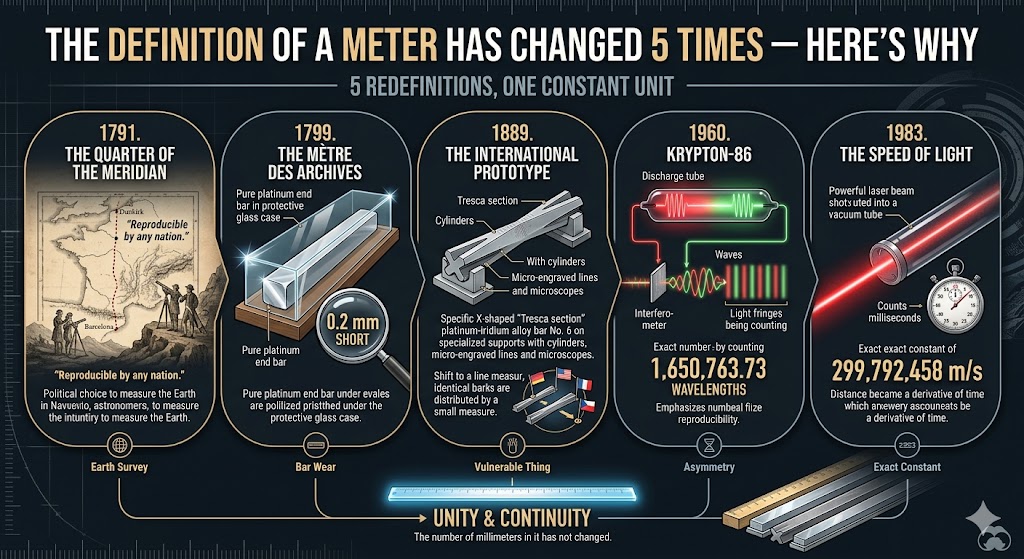
The meter has been redefined, formally, five times since 1791. The number of millimetres in it has not changed. That is the trick metrology pulls off, and once you see it, the whole history of the unit starts to look less like a series of revisions and more like a series of better and better explanations for the same fact.
I want to walk through the five, because the popular version of this story tends to collapse them — "first it was a piece of the Earth, then it was a bar, then it was light" — in a way that loses the actual reasoning. Each redefinition fixed a specific problem the previous one had created. That is the part worth seeing.
1791. The quarter of the meridian.
The first definition, voted by the French Academy of Sciences in March 1791 and formally adopted by the National Assembly, was that the meter would be one ten-millionth of the distance from the North Pole to the equator along the meridian passing through Paris. The choice of the meridian and the choice of the ten-millionth were not natural. They were political. The Academy wanted a unit that was not tied to any king's body, that any nation could in principle reproduce, and that connected the measurement of the world to the shape of the world. They got two of the three. The unit could not, in fact, be easily reproduced by anyone else, because measuring even a fraction of a meridian was a seven-year project requiring two astronomers, an army of permits, and a great deal of money. Delambre and Méchain spent from 1792 to 1799 surveying the arc from Dunkirk to Barcelona, and by the time they were done the republic that had commissioned them had been replaced twice.
This first definition was, in the technical sense, provisional. It pointed to a measurement that had not yet been completed. It told you what the meter was supposed to be, not what it was.
1799. The Mètre des Archives.
When the survey was finished, the meter had to be turned into a thing you could hold in your hand and compare other lengths against. The former royal jeweller — who had survived the Revolution by being useful — had been producing platinum bars about a meter long since 1795, with polished parallel ends. The one whose length most closely matched the surveyed value was deposited in the French National Archives on the 22nd of June 1799. The metric system itself was legalised by law on the 10th of December of the same year. This bar, the Mètre des Archives, was defined as the distance between its two polished ends at a specified temperature. It was, in the language of metrologists, an "end measure."
End measures are a bad idea, and the metrologists of 1799 already half-suspected this. The only way to compare another bar against an end measure is to touch its ends, which slowly wears the standard down. There was also a second, deeper problem, which would not be admitted out loud for another half-century: the Mètre des Archives was about 0.2 millimetres short of what it was supposed to be. Delambre and Méchain had used a slightly wrong value for the flattening of the Earth, and Méchain, by this point dead, had carried an additional error of his own that he had concealed in his notes. By the time the discrepancy was understood, too many measuring instruments had been calibrated against the Mètre des Archives for anyone to seriously consider correcting it. The bar was the bar.
1889. The International Prototype.
The first General Conference on Weights and Measures met in Paris on the 28th of September 1889 and adopted a new physical standard. The replacement was made of a 90% platinum, 10% iridium alloy — significantly harder than the pure platinum of the old bar — and cast in a peculiar X-shaped cross-section, the "Tresca section," named for the French engineer Henri Tresca who had designed it to resist torsional strain during length comparisons. The first castings of the alloy, in 1874, had failed; iridium had not yet been produced at sufficient purity. The job was eventually given to the London firm of Johnson, Matthey & Co., who delivered thirty bars to specification. One of them, No. 6, was determined to be as nearly identical in length to the Mètre des Archives as anyone could measure, and was designated the international prototype. The other twenty-nine were distributed by lot to the signatory nations of the 1875 Treaty of the Metre. The United States, drawing reasonably well, received No. 27.
This was not, strictly, a redefinition of how long a meter was. It was a redefinition of where the meter lived and how it was inscribed. The crucial technical move was the switch from an end measure to a "line measure" — the meter was now the distance between two fine lines engraved near the ends of the bar, not the distance between the bar's ends themselves. Lines could be located visually, with a microscope, without touching the standard. The bar would no longer wear down each time it was measured.
The 1889 wording was light on detail. It said only that "this prototype, at the temperature of melting ice, shall henceforth represent the metric unit of length." The 7th CGPM in 1927 tightened the definition substantially, specifying that the bar was to be measured at 0 °C, under one standard atmosphere of pressure, supported on two cylinders of at least one centimetre diameter, symmetrically placed 571 millimetres apart. The fact that they had to specify the spacing of the supports tells you everything about how seriously they took the problem of the bar bending under its own weight.
1960. Krypton-86.
The first three definitions all had the same flaw: the standard was a thing. A thing can be lost, stolen, scratched, dropped, slightly bent. A thing has to be brought to a laboratory to be compared against another thing. By the 1950s, interferometry had developed to the point where a wavelength of light could be measured more reproducibly than the position of a scratch on a platinum-iridium bar. The 11th CGPM, meeting on the 20th of October 1960, defined the meter as 1,650,763.73 wavelengths in vacuum of the radiation corresponding to the transition between the 2p10 and 5d5 energy levels of the krypton-86 atom.
The reasoning was simple, even if the number was not. A krypton-86 atom in Tokyo emits light at exactly the same wavelength as one in Paris. There is no shipping required. Any sufficiently equipped laboratory could realise the meter for itself by exciting the right isotope and counting fringes in an interferometer. The standard had moved from a vault in Sèvres to anywhere in the world that could be made cold enough and clean enough.
The number 1,650,763.73 was not chosen because it was elegant. It was chosen because it made the new meter as close as humanly possible to the length of Prototype No. 6 sitting in the vault. The whole point of every redefinition is that the unit does not change. Only the way it is specified does.
1983. The speed of light.
The krypton standard turned out to have a problem nobody had quite anticipated. The same year the 11th CGPM adopted it, 1960, the first working laser was built. Laser light is highly monochromatic and coherent in a way that krypton discharge light is not, and measurements of laser wavelengths against the krypton line quickly revealed that the krypton emission was slightly asymmetrical — different parts of the line gave slightly different wavelengths. The krypton meter was reproducible to better than one part in a hundred million, but the lasers were getting better fast, and the standard was about to become the limiting factor.
The 17th CGPM, on the 20th of October 1983, made the move that, in retrospect, was always the move metrology was heading toward: it defined the meter in terms of the speed of light. The meter is now the length of the path travelled by light in a vacuum during 1/299,792,458 of a second. The number 299,792,458 — the speed of light in metres per second — became, by international agreement, exact. It is no longer measured. It is defined.
This is the inversion that the 1983 definition pulled off. Before 1983, you measured the speed of light by measuring distance and time. After 1983, you measured distance by measuring time and multiplying by a defined constant. The meter became a derivative of the second, which had been defined since 1967 in terms of the cesium atom. The 2019 revision of the SI reworded the definition to make the dependence on the cesium frequency explicit, but did not change the size of the meter by anything you could detect.
So: five definitions. Quarter of the Earth, platinum end bar, platinum-iridium line bar, krypton wavelength, speed of light. Each one fixed a problem in the previous one. The Earth-arc was unreproducible without re-doing the survey. The platinum bar wore down at its ends. The platinum-iridium bar was vulnerable to fire, theft, and the slow oxidation of metal. The krypton line was asymmetrical. The speed-of-light definition has so far resisted all attempts to break it, although metrologists already note that the speed of light is affected by gravitational fields and that the 1983 wording does not account for this. There will probably, eventually, be a sixth.
The thing that strikes me about this history, the more time I spend with it, is that the goal of all five redefinitions was the same: to make the meter not change. Each new definition was chosen specifically because it would yield, to within the precision of the previous standard, exactly the length the previous standard had specified. The bar in 1889 was selected to match the Mètre des Archives. The number 1,650,763.73 was selected to match the bar. The number 299,792,458 was selected to match the krypton wavelength. The whole point of redefinition is continuity. We have been measuring the same meter for two and a quarter centuries. We have simply gotten progressively better at saying what we mean by it.
That is, I think, the most beautiful thing about metrology. It looks like a science of measurement. It is actually a science of stability — of arranging the world so that the answer you get today is the same as the answer you got yesterday, even though everything about how you got the answer has changed.