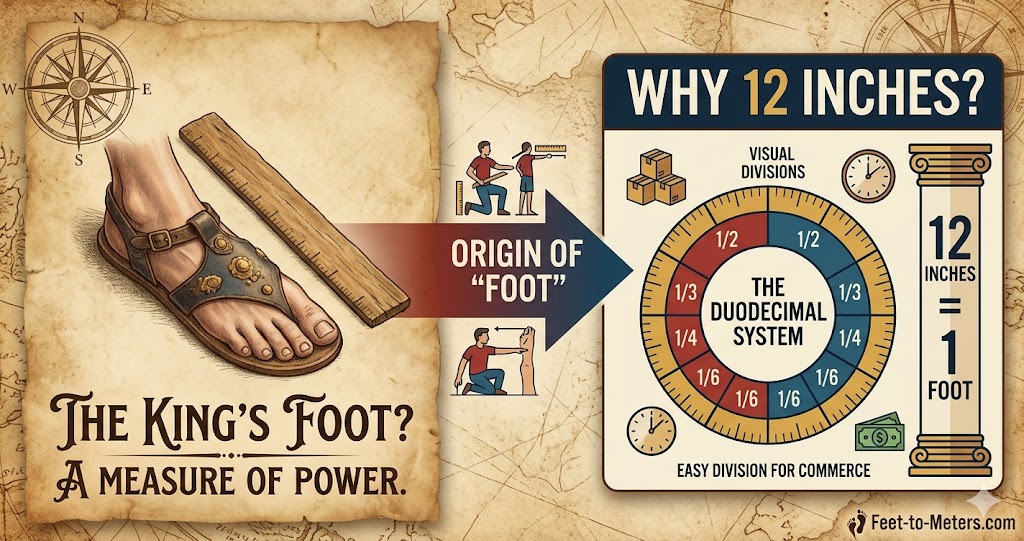
The story you have probably heard is that the foot is twelve inches because some English king — Edward II in one version, Henry I in another — had a foot of that length and decreed it the law of the realm. It is a charming story. It is also, on the evidence, almost entirely made up. Neither claim appears in any primary source I have been able to find from the relevant centuries. Both seem to surface in the popular literature long after the foot was already standardised at twelve inches, and both have the suspicious tidiness of folk etymology — the kind of story people invent backwards to explain a name whose actual origin is duller and older and not really about a king at all.
The real story starts in Rome, and arguably in Greece before that. The Greek pous and the early Roman pes were divided, like most ancient foot-units, into sixteen digiti — finger-breadths. Sixteen is a useful number for craftsmen. It halves cleanly, and halves again, and halves again, which is what a carpenter or a stonemason actually wants to do with a rule. The architect and engineer Vitruvius, writing in the first century BC, gave the foot its anthropometric justification: a man's foot, he said, was one-sixth of his total height, and the proportions of the body were the proportions of good building. This is not a definition. It is a rationalisation. The unit existed first; the theory came later.
What the Romans then did, and this is the move that actually matters for our story, was to overlay a second division onto the foot. They began to divide it not only into sixteen digiti but also into twelve unciae — twelfths. The word uncia simply means a twelfth part, and the Romans applied it to a great many things, including the as, their copper unit of value, and the libra, their unit of weight. From uncia, by perfectly regular sound-change, English gets both "inch" and "ounce" — two words that started life as the same word and meant the same thing: one-twelfth. Frontinus, writing on land surveying in the first century AD, mentions that the digitus was still in everyday use in Campania and most of Italy; the uncia, meanwhile, was making its way into the foot from the side, brought in by the Romans' growing fondness for the duodecimal divisions they had already adopted in their weights and their coinage. Twelve is divisible by two, three, four, and six. Sixteen is divisible by two, four, and eight. For a system that needs to express thirds and quarters of a unit cleanly — and most pre-modern commerce needs to express thirds — twelve wins.
So: the foot became twelve inches because the Romans, for reasons of arithmetical convenience having nothing to do with royal anatomy, found it useful to layer a duodecimal division onto an existing sixteen-part unit, and the duodecimal division eventually won. The earliest English word for an inch, ynce, comes directly from uncia. The number twelve was already inside the foot a thousand years before any English king got his name attached to it.
How long was this Roman foot, exactly? Here the historical record gets agreeably specific and slightly irritating. The standard modern estimate is about 296 mm, or roughly 11.65 modern inches — slightly shorter than today's foot. The figure comes from surviving Roman folding rules, from the paving-stones of the Pantheon, from the milestones of the Appian Way, and from a remarkable seventeenth-century investigation that deserves more credit than it gets. In 1639, an English astronomer named John Greaves — better known for his work on the pyramids — travelled to Rome with the explicit aim of measuring the Roman foot. He measured, among other things, the foot-rule carved on the tomb of Titus Statilius Aper, the foot inscribed on a statue formerly in the gardens of Angelo Colocci, the congius of Vespasian, and several brass measuring-rods that had been dug up in the ruins. He published the results in 1647 as A Discourse of the Romane Foot, and Denarius. It is one of the founding documents of modern metrology, and it is reliable enough that subsequent measurements have largely confirmed it.
But the Roman foot was never one length. The pes Drusianus, named after Nero Drusus and used widely in the Roman provinces — particularly Germania Inferior, the Rhine frontier — was about 333 or 335 mm. That is roughly thirteen modern inches, about an inch longer than the city foot. Wherever you went in the empire, you might be standing in a province where the local pes was different from the one used in Rome, sometimes by margins large enough to matter for a building or a piece of land. This variability was not a bug. It was simply how units worked in a pre-industrial world. The foot was a habit before it was a length.
After the empire fell, the habit fragmented further. Charlemagne attempted, in 790, to standardise the units of measure across his domain. He failed, as the archaeology of his own buildings confirms: at Charlieu Abbey, the ninth-century construction used something close to the Roman foot of 296 mm, while the tenth-century rebuilding used a foot of about 320 mm. Within a single building, two different feet. In England, the situation was complicated further by the survival of older units. Anglo-Saxon builders inherited a North German or "Belgic" foot of about 335 mm — close to the pes Drusianus — and used it alongside, or in competition with, the older Roman foot, which continued in the construction trades.
The decisive English settlement, the one that fixed the modern foot at twelve inches as a matter of law, was not made by a king holding out his foot for measurement. It was made in a document called the Compositio Ulnarum et Perticarum — the Composition of Yards and Perches — whose date the historians place somewhere between 1266 and 1303. There are two surviving readings. The one in the manuscript known as Cotton MS Claudius D 2 declares, with the impatient brevity of a working statute: It is ordained that 3 grains of barley dry and round do make an inch, 12 inches make 1 foot, 3 feet make 1 yard, 5 yards and a half make a perch, and 40 perches in length and 4 in breadth make an acre. The other reading, from a manuscript called Liber Horn, is even more revealing: And be it remembered that the iron yard of our Lord the King containeth 3 feet and no more, and a foot ought to contain 12 inches by the right measure of this yard measured, to wit, the 36th part of this yard rightly measured maketh 1 inch.
This is the part the king's-foot folklore gets backwards, and it is worth being precise about. The medieval English yard was the primary standard. There was an actual iron bar — the "iron yard of our Lord the King" — kept at Westminster, defined first by an Assize of Measures under Richard I in 1196 and reaffirmed afterwards. The foot was not a unit that produced the yard. It was a fraction of the yard: one-third of that iron bar, divided into twelve inches because the Roman habit of twelve had survived and was now being written into English statute. The inch, in turn, was anchored physically by three dried barleycorns laid end to end — a definition that sounds whimsical but was perfectly serviceable, since the relevant grain varieties produced kernels averaging about a third of an inch with reasonable consistency.
So when a popular history tells you that Edward II's foot was twelve inches, or that Henry I defined the yard as the distance from his nose to his outstretched thumb, what it is doing is taking the medieval iron yard, projecting it back onto a royal body, and inventing a story to explain the result. The actual statute does not name a king's anatomy. It names the iron bar.
The foot we use today is exactly 0.3048 metres, fixed by international agreement in 1959 between the United States, the United Kingdom, Canada, Australia, New Zealand, and South Africa. That number was not chosen because anyone's foot is exactly that long. It was chosen because it was the cleanest available reconciliation of the slightly different English-speaking feet that had drifted apart over the previous centuries, each one anchored to its own national yardstick.
I find this story, in the aggregate, more satisfying than the fairy-tale version, though I understand why the fairy-tale version persists. It is easier to remember that a king held out his foot than to remember that twelfths beat sixteenths because they divide more cleanly, that uncia gave us both "inch" and "ounce," that the Roman foot came in at least two lengths across the empire, that Charlemagne tried and failed, that a thirteenth-century English statute defined the inch as three barleycorns and the foot as one-third of the iron yard at Westminster, and that the 12-inch foot we use today is in the end a duodecimal habit inherited from people who liked dividing things into thirds. The foot was not named after anyone. It was named after feet, the body part, which most adults possessed and which gave a roughly comparable result when laid end to end across a piece of ground. The twelve is older than English kings and probably older than written history. It is the part of the unit that has the most genuine claim to being ancient.
What I keep coming back to is that "the foot" is less a single length than a stubborn way of cutting the world. The exact length has wandered between about 290 and 335 mm for as long as we have records, and even today the international foot, the US survey foot, and the various continental feet that fell out of use only in the last two centuries differ by amounts that would matter if you were building something across a national border. The name and the number are stable. The thing itself, like most things in metrology, has always been slightly negotiable.