The thing the pirate story gets wrong is the ending.
You have probably heard the pirate story. It is the one that gets trotted out every time a foreigner asks an American why their plywood is sold in feet. In 1793, the French botanist Joseph Dombey set out from Le Havre carrying two small objects of revolutionary importance: a copper rod exactly one metre long, and a small cylinder, also of copper, weighing exactly one grave — the original name for what we now call the kilogram. He was bringing them to Philadelphia, at the invitation of Thomas Jefferson, then Secretary of State. Jefferson, an avid Francophile and an inveterate tinkerer with units, had been pushing a decimal-based system of weights and measures since at least his 1790 Plan for Establishing Uniformity in the Coinage, Weights, and Measures of the United States, which he had laid before Congress with the kind of cool rationalist enthusiasm that he applied to almost everything. The French standards were to be examined, copied, and possibly adopted.
Dombey never arrived. A storm blew his ship south into the Caribbean, where it was boarded by British privateers — pirates with paperwork, holders of letters of marque from a Crown that was, as usual, at war with France. Dombey, who had reportedly disguised himself as a Spanish sailor when he saw the privateers coming, was unmasked, taken prisoner, and died in captivity on the island of Montserrat. His belongings were auctioned. The metre and the grave were eventually purchased by intermediaries and made their way, by a circuitous route, to Edmund Randolph, who had succeeded Jefferson as Secretary of State. By the time they arrived, the political moment had passed. Congress did nothing.
This is the part of the story everyone tells. The part nobody tells is what happened next, which is, essentially: America said yes to the metric system, several times, in increasingly emphatic legal language, over a period of roughly 130 years — and then never actually used it.
The Act of July 28, 1866 made the metric system legal for use in US trade. The United States was one of the seventeen original signatories of the Treaty of the Metre in 1875, sitting down in Paris alongside France and Germany and Italy and pledging to maintain international prototypes of length and mass. The two metres and two kilograms allotted to the US arrived in 1890, made of the same platinum-iridium alloy as the international standards at Sèvres, and the question of what to do with them was kicked over to the Office of Weights and Measures within the US Coast and Geodetic Survey, whose superintendent at the time was Thomas Corwin Mendenhall.
Mendenhall was a physicist from Ohio who had once climbed Mount Fuji to measure the density of the Earth. He was not a man given to vagueness. On the 5th of April 1893, with the approval of Treasury Secretary John G. Carlisle, he issued what became known as the Mendenhall Order — formally, Bulletin No. 26 of the Coast and Geodetic Survey, Fundamental Standards of Length and Mass. The text is dry and short and somewhat startling if you have only ever heard the pirate story. It announces that the Office of Weights and Measures will, from now on, regard the International Prototype Metre and Kilogramme as the fundamental standards of the United States, and that "the customary units — the yard and the pound — will be derived therefrom." In other words: as of April 1893, the American yard was not a thing in itself. It was a fraction of a metre. The American pound was a fraction of a kilogram. The customary system did not stop existing. It simply stopped being primary. Mendenhall, with the stroke of an administrative pen, made the United States a metric country at the level of fundamental measurement.
This is the fact that the pirate story is structurally incapable of containing. The pirates did not stop the metric system from reaching America. The metric system reached America. It became the foundation of every official measurement made on US soil. The yard you used yesterday to measure the carpet was, legally, exactly 0.9144 of a metre — a value that was already implicit in 1893 and was made exact by international agreement in 1959. The pound of beef in your fridge is 0.45359237 of a kilogram, no more, no less, by US federal definition. Americans have been buying meat and lumber in metric for a very long time. They have just been doing it through a translation layer that nobody mentions on the label.
What the United States did not do, and has still not done, is the second part — the part where the legal foundation works its way upward into everyday life. Britain, Australia, Canada, India, every country that converted in the twentieth century, did this through a combination of legislation, deadlines, public campaigns, and a certain amount of stubborn governmental willingness to absorb the short-term annoyance of changing the road signs. The United States tried, twice, and both times the attempt was structured in a way almost designed to fail.
The first attempt was the Metric Conversion Act of 1975, Public Law 94-168, signed by Gerald Ford on the 23rd of December. Read Ford's signing statement and you will see a curious double motion. On one hand, he describes the law as historic, invokes George Washington's first message to Congress in January 1790 (in which Washington had called for uniform weights and measures), and notes the 1875 Treaty of the Metre. On the other hand, he repeatedly emphasises that the conversion is to be "completely voluntary." The Act established a United States Metric Board to "coordinate" the voluntary changeover and to "educate the American people," but it gave the board no enforcement power, no funding mandate, no deadline. The board spent its first two years not even fully constituted, because Ford's nominations were not acted on before he left office and Carter had to make new ones, most of whom were confirmed in March 1978.
In 1982, Ronald Reagan abolished the Metric Board entirely, on the advice of Frank Mankiewicz and Lyn Nofziger. It had existed for less than five years as a functioning body.
The second attempt was the Omnibus Trade and Competitiveness Act of 1988, which amended the 1975 law and designated metric as the "preferred" system for federal procurement, with a 1992 target for executive-branch agencies. This is the law that, more than any other, explains why NASA, the military, and large parts of the federal scientific apparatus are metric in their internal workings. It is also a law almost no American outside those institutions has ever heard of, and it carried no provisions for the supermarket, the highway, the hardware store, or the schoolroom.
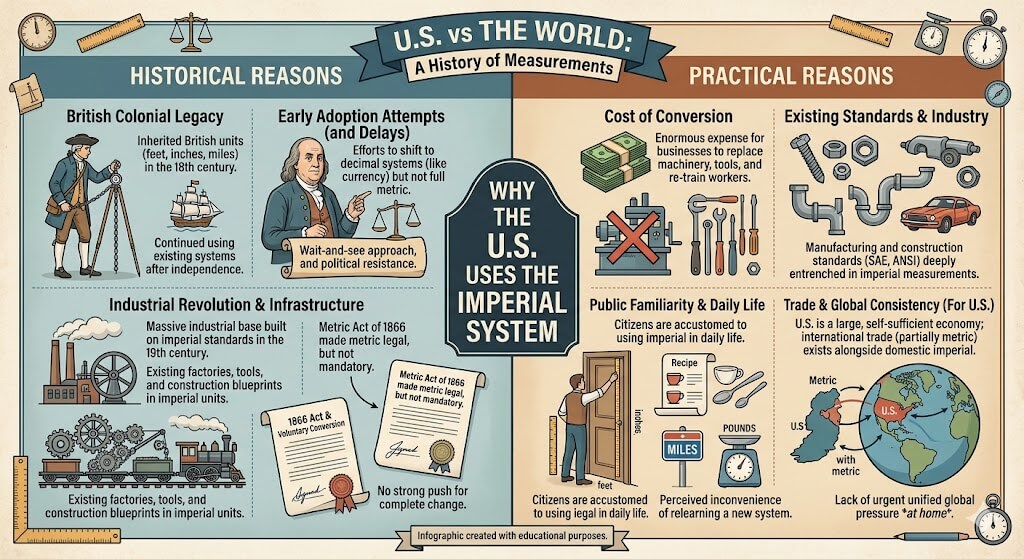
The question, then, is not why America rejected the metric system. America did not reject it. America accepted it at every level the federal government can act on alone — fundamental standards, treaty obligations, scientific practice, federal procurement — and then declined, repeatedly and on a bipartisan basis, to push the change into the parts of life that ordinary people touch. The reasons are dull and structural and worth saying plainly. Conversion costs money — re-machining tools, repainting signs, reprinting textbooks, retraining workers — and the costs fall on identifiable industries and constituencies, while the benefits are diffuse and long-term. There is no powerful domestic lobby for the meter and there are many for the foot. The political reward for forcing the change is small. The political punishment for the disruption it would cause is large. And, crucially, the United States is large enough and economically central enough that it has been able to make the rest of the world bend toward it on units more often than it has had to bend the other way.
The pirate story is fun because it locates the failure in a single dramatic moment in 1794, somewhere off Montserrat, with Dombey dying in captivity and the grave lost to history. The truth is duller. The failure is in 1975, when a Republican president signed a metric law that he simultaneously rendered toothless by calling it voluntary. The failure is in 1982, when a conservative White House decided that even the small symbolic institution of a metric board was not worth defending. The failure is in every two-by-four sold today in the United States, which is sold in feet not because Dombey's ship was boarded but because no one has ever quite decided that the cost of changing the label is worth paying.
Whether that decision is permanent, I do not know. The US is more metric now than it was in 1975, in ways most Americans never notice — soft drinks, medicine, cars built for export, almost all scientific work, almost all federal contracts. The gap is between the visible culture and the invisible infrastructure, and gaps of that kind have a way of either closing slowly or persisting forever. I would not bet on which.
What I am sure of is this. The United States is not the country that said no to the meter. It is the country that said yes, and yes again, and yes a third time, in increasingly small print, and then went on selling lumber in feet anyway. That is not a story about pirates. It is a story about how a country can adopt something at the top and never quite mean it. And it is, on the evidence, a story that has not finished.